

How Much is Taken Out of Your Social Security Check for Medicare?
If you receive Social Security benefits and are enrolled in Medicare, you may notice that your monthly benefit is lower than your gross payment amount. That's because many Medicare beneficiaries have their Medicare premiums automatically deducted from their Social Security checks. Understanding exactly how much is taken out and why can help you better plan your retirement income.
Medicare and Social Security: How They Work Together
For most retirees, Medicare Part B premiums are automatically deducted from their monthly Social Security benefits. This arrangement is convenient because you don't have to worry about making separate payments for your Medicare coverage. The Social Security Administration (SSA) collects the premium and forwards it to Medicare.
The amount deducted depends on several factors, including:
- The Medicare coverage you have
- Your income level
- Whether you pay any late enrollment penalties
- Whether you owe income-related surcharges (IRMAA)
Let's break down the costs.
The Standard Medicare Part B Deduction
Medicare Part B covers outpatient medical services, including:
- Doctor visits
- Preventive care
- Outpatient hospital services
- Durable medical equipment
- Physical and occupational therapy services
In 2026, the standard Medicare Part B premium is $202.90 per month for most beneficiaries. This amount is typically deducted directly from Social Security payments.
For example:
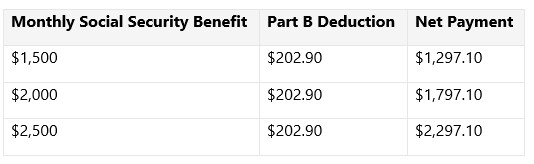
Your actual Social Security payment will be the benefit amount minus any Medicare premiums and other deductions that apply.
Why Some People Pay More
Not everyone pays the standard Medicare Part B premium.
Higher-income beneficiaries may be subject to an additional charge called the Income-Related Monthly Adjustment Amount (IRMAA). Social Security determines whether you owe IRMAA using income information from your federal tax return, generally from two years earlier.
For 2026, individuals with modified adjusted gross income above $109,000 or married couples with income above $218,000 may pay higher Medicare premiums. Depending on income, total Part B premiums can range from $284.10 to $689.90 per month.
This means a higher-income retiree could see significantly more deducted from their Social Security check than someone paying the standard premium.
Are Medicare Part D Premiums Also Deducted?
They can be.
Medicare Part D provides prescription drug coverage. If you choose to have your Part D premium deducted from your Social Security payment, Medicare can arrange for automatic withholding. Additionally, high-income beneficiaries who owe a Part D IRMAA surcharge will generally have that amount deducted from their Social Security benefits as well.
Because Part D plans are offered by private insurers, premiums vary widely. Some people may pay less than $10 per month, while others pay substantially more depending on the plan selected.
What About Medicare Part A?
Most retirees do not pay a Medicare Part A premium because they or their spouse paid Medicare taxes during at least 10 years of employment.
However, if you don't qualify for premium-free Part A, in 2026 you may have to pay:
- $311 per month if you have 30 to 39 quarters of Medicare-covered employment
- $565 per month if you have fewer than 30 quarters of coverage
Most Social Security recipients never see a Part A deduction because they qualify for premium-free coverage.
Can Medicare Reduce Your Cost-of-Living Increase?
Sometimes retirees worry that Medicare premium increases will offset their annual Social Security Cost-of-Living Adjustment (COLA).
A provision commonly known as the hold-harmless rule protects many beneficiaries. Under certain circumstances, Medicare Part B premium increases cannot reduce a person's net Social Security payment from one year to the next. This protection applies to many, but not all, beneficiaries.
For example, if your Social Security benefit increases by $20 due to COLA and your Part B premium increases by $15, your net payment still increases by $5.
However, some individuals, including those paying IRMAA surcharges, may not receive the full benefit of this protection.
How to Find Your Exact Medicare Deduction
If you're unsure how much Medicare is taking out of your Social Security check, there are several ways to find out:
- Review your annual Social Security benefit statement.
- Log into your my Social Security account online.
- Check your Medicare Premium Bill if you receive one.
- Review your monthly Social Security payment notice.
- Contact the Social Security Administration directly.
Your statement typically shows:
- Gross Social Security benefit
- Medicare premium deductions
- Any additional deductions
- Net benefit payment
Examples of Medicare Deductions
Let's look at a few common scenarios.
Example 1: Standard Premium
- Social Security benefit: $2,100
- Medicare Part B premium: $202.90
Net monthly payment: $1,897.10
Example 2: Higher-Income Beneficiary
- Social Security benefit: $3,000
- Part B premium with IRMAA: $405.80
Net monthly payment: $2,594.20 before any other deductions.
Example 3: Part B Plus Drug Coverage
- Social Security benefit: $2,000
- Part B premium: $202.90
- Part D premium: $40
Net monthly payment: $1,757.10. Part D premiums vary by plan.
Tips for Managing Medicare Costs
Although Medicare premiums are unavoidable for most beneficiaries, there are ways to manage healthcare expenses:
- Review your Medicare coverage annually.
- Compare Part D drug plans during Open Enrollment.
- Check eligibility for Medicare Savings Programs.
- Monitor income levels if IRMAA surcharges may affect you.
- Appeal an IRMAA (Income-Related Monthly Adjustment Amount) determination if a major life event has reduced your income.
Conclusion
For most retirees, the amount taken out of a Social Security check for Medicare is the standard Medicare Part B premium for that year. However, higher-income beneficiaries may pay significantly more because of IRMAA surcharges, and additional deductions may apply for Medicare Part D prescription drug coverage.
The easiest way to determine your exact deduction is to review your Social Security statement or online account. By understanding how Medicare premiums affect your monthly benefit, you can create a more accurate retirement budget and avoid surprises throughout the year.
Our team of dedicated, licensed agents can help you as little or as much as you need. Whether it’s answering a few questions about Medicare or creating a comprehensive Medicare Planner with you, we are your Senior Allies.
Email Us Now